
Bethel African Methodist Episcopal Church, Lynn
Sunday February 11, 2024
Rev. Laura Everett
Transfiguration Sunday
Mark 9:2-9 NRSV
Six days later, Jesus took with him Peter and James and John and led them up a high mountain apart, by themselves. And he was transfigured before them, and his clothes became dazzling white, such as no one on earth could bleach them. And there appeared to them Elijah with Moses, who were talking with Jesus. Then Peter said to Jesus, “Rabbi, it is good for us to be here; let us make three dwellings, one for you, one for Moses, and one for Elijah.” He did not know what to say, for they were terrified. Then a cloud overshadowed them, and from the cloud there came a voice, “This is my Son, the Beloved; listen to him!” Suddenly when they looked around, they saw no one with them anymore, but only Jesus.
Dear Sir:
At a meeting of the colored Washerwomen of this city, on the evening of the 18th of June, the subject of raising the wages was considered, and owing to many circumstances, the following preamble and resolution were unanimously adopted:
Whereas, under the influence of the present high prices of all the necessaries of life, and the attendant high rates of rent, while our wages remain very much reduced, we, the washerwomen of the city of Jackson, State of Mississippi, thinking it impossible to live uprightly and honestly in laboring for the present daily and monthly recompense, and hoping to meet with the support of all good citizens, join in adopting unanimously the following resolution:
Be it resolved by the washerwomen of this city and county, That on and after the foregoing date, we join in charging a uniform rate for our labor, that rate being an advance over the original price by the month or day the statement of said price to be made public by printing the same, and any one belonging to the class of washerwomen, violating this, shall be liable to a fine regulated by the class. We do not wish in the least to charge exorbitant prices, but desire to be able to live comfortably if possible from the fruits of our labor.
We present the matter to your Honor, and hope you will not reject it as the condition of prices call on us to raise our wages. The prices charged are:
$1.50 per day for washing; $15.00 per month for family washing; $10.00 per month for single individuals.
We ask you to consider the matter in our behalf, and should you deem it just and right, your sanction of the movement will be gratefully received.
Yours, very truly,
The Washerwomen of Jackson, Mississippi.
A letter written to Mayor Barrows on June 20, 1866.
Let us pray: God, I am bold to stand before your people and proclaim a Word. So grant us the Word we need to hear in our lives this day, You our rock and our redeemer. Amen.
Church, it is a great joy and honor to be here with you at the Historic Bethel African Methodist Episcopal Church in the City of Lynn, Massachusetts today, on this last Sunday before we begin the holy season of Lent. I am so grateful to you for the sacred and brave work you are doing to give your pastor Rev. Bernadette a longer rest to restore her body and spirit. This is not easy nor is it familiar, but you set example for the whole Church that it is possible and necessary to rest. Work without rest is a weapon of white supremacy and when we can resist it, we honor God and practice sabbath that liberates us all. Caring for one another, as women, Black folk, queer folk, poor folk, elders, people with disabilities, in a world that was never set up for our thriving must be a whole community effort, and so please hear my gratitude and admiration. Thank you. Bless you. I honor you for your holistic vision of thriving in community and I will tell your story to the other churches I visit in the wide network of the 18 denominations that are a part of the Massachusetts Council of Churches.
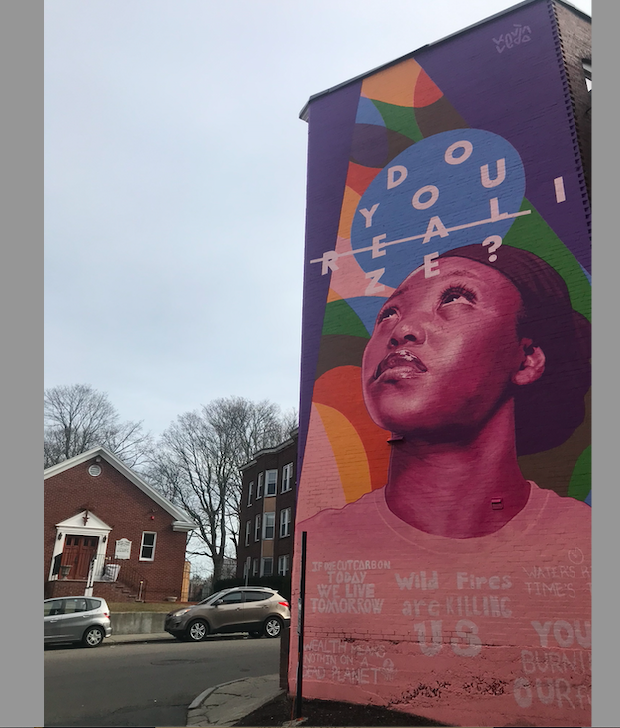
The Scripture read by Brother Chris we have before us today on this Transfiguration Sunday comes from the Gospel of Mark, who is always brief and rarely clear, chapter 9 verses 2-9 and I’ve read from the New Revised Standard Version. Now you good Bible reading church folx know that the text gives us clues to pay attention that something big is coming. Big things happen on mountain tops. Moses gets the ten commandments up on the mountain. Jesus is brought by the devil up on the mountain to view the city below and reject the devil’s temptations. And here, up on a high mountain apart, Jesus is transfigured.
I want us to come up real close to these verses 2-3, “And Jesus was transfigured before them, and his clothes became dazzling white, as no one on earth could bleach them.”
Church, what does it mean to be transfigured? We get the outward sign here- Jesus’s clothes change. But what is this word? We don’t use it much. The original Greek helps us a little, μετεμορφώθη, or metamorphosee, metamorphosis or transformed. Jesus is transformed. That sounds more familiar, right? You’ve heard that before in Paul’s letter to the church in Rome, the 12th chapter. Rom. 12:2 “Do not be conformed to this world, but be transformed by the renewing of your minds, so that you may discern what is the will of God—what is good and acceptable and perfect.” We’re after that inward change of our minds. The transformation of our minds, and the transfiguration of the externals are simply a sign of this.
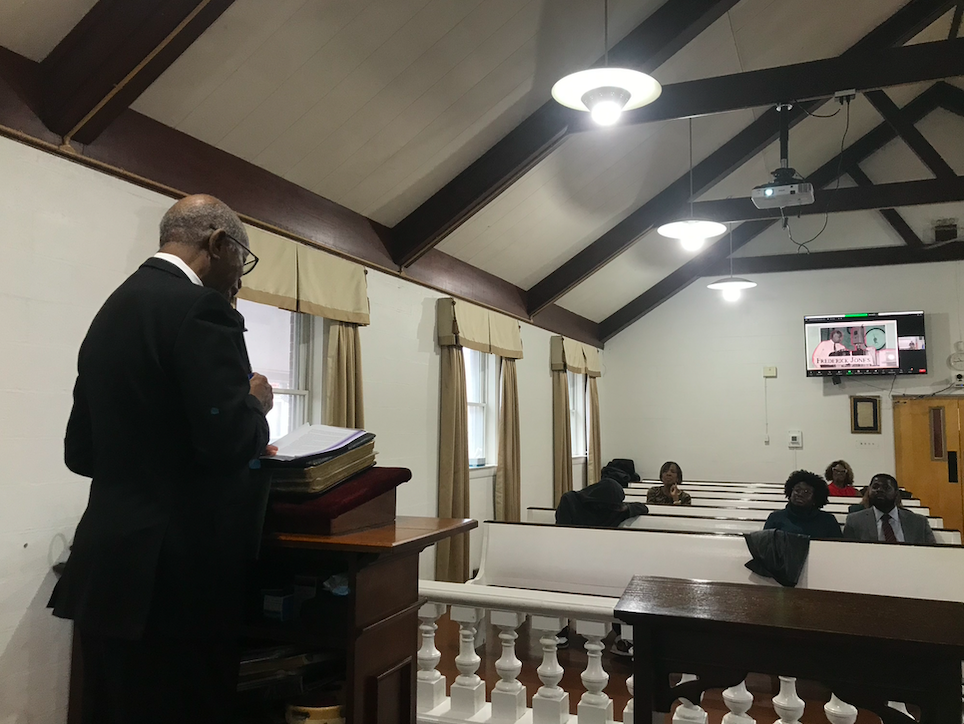
Sometimes we do the reverse, maybe if I put on this red lipstick, I will feel confident. Maybe if I put on this suit, I will feel put together. We try to dress ourselves into believing who we are. We have to know on the inside what is true.
Because you know the danger. You know this history. External forces are pushing real hard in these days. Some folks are saying Black History isn’t American history.
Because too often in American history, some have confused this transfiguration with whiteness. Some of us got this verse tangled up. We heard that Jesus’s clothes turned dazzling white and thought that Jesus turned white too. But that is inaccurate reading of God’s word. And we rebuke it with all that mountaintop power we have.
That 1866 letter I read at the beginning? By gathering, organizing, and knowing their collective worth knowing on the inside, the Black women, when “They signed their letter “The Washerwomen of Jackson,” and in doing so, gave a name to Mississippi’s first trade union.” That is the power, first in our own mind, and then collectively knowing we are God’s beloved. Knowing in the depth of our being.
Church, the first step is knowing in our own mind that we are worthy. Deeply, fundamentally, and foundationally worthy. No law, no word, no circumstance, no change in condition can change this. We have to know with every fiber of our being that we are God’s beloved. That is the work of today and the work of a lifetime.
And what the Black washerwomen of Jackson, Mississippi knew is to turn clothing dazzling white requires that they be treated with dignity and respect. You must do the internal work, before the external change shows.
Freedom is contagious, Church. When we start getting free and knowing our own worth, others catch a glimpse and want to join in. First you imagine it’s possible, then you get brave, then we all get free. Possible, brave, free.
So after the Black washerwomen of Jackson, Mississippi claim their own dignity and power in 1866, in 1877 there was another movement of Black washerwomen, this time in Galveston, Texas.
In July and August, the white wives, and daughters of the striking railroad workers in the laundry business were pressed into solidarity with the Black Washerwomen to demand $1.50 a day wages. Possible, brave, free.
All of this led to the creation of the Washing Society in Atlanta in July 1881. Black women went door to door organizing other domestic workers, and meeting in, where were they meeting? Black churches! They were meeting in Black churches! And on July 19, 1881 the Washing Society declared a strike for pay of $1 for 12lbs a load wages. You have to do the internal work before the external change, beloved.
A week into the strike on July 26, 1881, the local newspaper, the Atlanta Constitution reported “The Washerwomen’s strike is assuming vast proportions and despite the apparent independence of the white people, is causing quite an inconvenience among our citizens.” That sentence tells you everything you need to know about who the local newspaper thought “our citizens” are. Even if the local newspaper doesn’t know your worth, you must, beloved. You must know your worth.
Ten days into the strike, police arrested six of its leaders. We call the names of these saints and ancestors: Matilda Crawford, Sallie Bell, Carrie Jones, Dora Jones, Orphelia Turner and Sarah A. Collier — were described in the press as “ebony-hued damsels.” When what they were was organizers, movement makers, community leaders and powerful, faithful Black women leading the Washing Society and expanding the strike. The city went back and forth with the Washing Society, with the City Council getting involved. The International Cotton Exposition was scheduled to begin shortly in Atlanta, with Northern businessmen and international travelers expecting hotels with clean sheets, and a threat of a general strike loomed.
Freedom is contagious, and the white establishment of 1881 Atlanta was worried about the spread. The Atlanta Journal Constitution newspaper wrote, “There are some families in Atlanta who have been unable to have any washing done for more than two weeks. Not only the washerwomen, but the cooks, house servants, and nurses are asking increases.”
As the Atlanta City Council proposed annual fees on the Washing Society, the leaders wrote to the Mayor. Their words show a people transformed, knowing their own worth. Their letter ended with a warning: “Don’t forget this. We hope to hear from your council on Tuesday morning. We mean business this week or no washing.”
To be so bold. To be so brave. To stand up to such power in the face of such overwhelming odds?
Let’s examine their statement like sacred text it is: Hear it again: “Don’t forget this. We hope to hear from your council on Tuesday morning. We mean business this week or no washing.”
The Washing Society know their own worth, and act from that confidence. They write in hope, putting forth a vision of a collaborative future where everyone is thriving. They set a clear deadline. They name the consequences if consensus is unable to be met. They are clear, dazzlingly clear about who they are and what they need. They are God’s beloved, and they are not going to settle for anything less. If they are going to turn clothes dazzling white, they are going to be paid a dignified wage.
Church, I’m going to go Baptist and tell you it takes three things to operate with this clarity, and you can write them down:
- Knowing we are God’s Beloved
- Knowing our particularity
- Knowing our history
Let me say this- we can only do this collectively. There’s a reason Jesus takes up the three disciples, and sends us out in twos and threes. The mission of knowing God’s expansive love is not a solo project. We have to do this collaboratively. The devil works his worst when we are isolated.
To know our particularity is to know what is yours and yours alone. These Black women leaders knew what only they could do, and what their city depended on them to do. Each of us are fearfully and wonderfully made, particularly made. Not a single other person in the world like us, and God doesn’t need duplicates. We need to know exactly who we are in order to get free together. Each of our particularity is by the Holy One’s design.
Knowing our history is a reminder that we have examples, saints and ancestors and stories of liberation before us. We have models and ministries that give us examples and inspiration. We don’t need to make a rounder wheel. We might need to adapt, we might need to try something new, but to know our own history, our Black history, our womanist history, our native and queer and feminist and indigenous and stolen histories is part of what helps us know that we need not be afraid of the future. I am not afraid of what is going to happen to the Church because the Church is eternal.
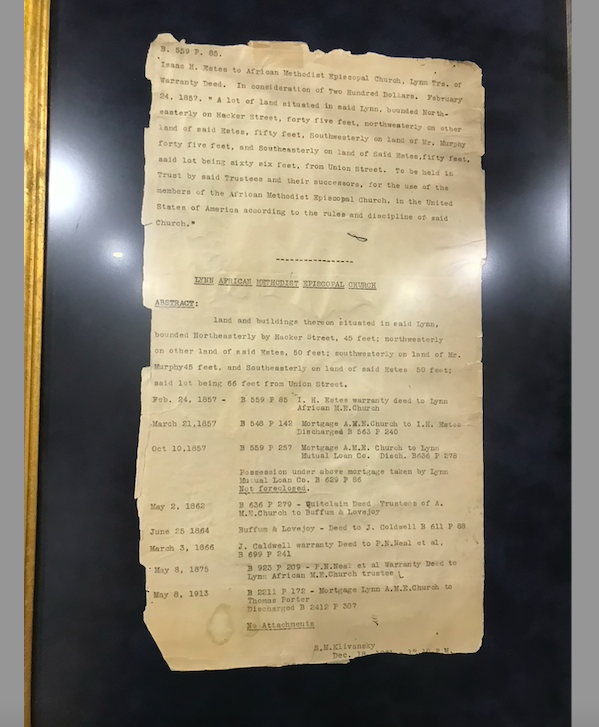
The church was founded in 1857.
And our work, our work today is to make sure we know in our bones that to be transfigured is to know we are God’s beloved. We are dazzling. We are worthy. Our whole faith is dedicated to telling the story that God is so dedicated to loving us as to become us.
We have to be transformed from a world that is dead set on telling us we are trash and instead to know our belovedness, know our particularity as each of us is made, and know our history so that no one, no thing, no force can take it away.
Which brings us to brother Peter. Dear sweet brother Peter. I have such sympathy for Brother Peter.
Look with me at verse 5. “Then Peter said to Jesus, “Rabbi, it is good for us to be here, Let us make three dwellings, one for you, one for Moses, and one for Elijah.” He did not know what to say for they were terrified.”
Brother Peter is running at the mouth. There is no church mother there to hush him up. “He did not know what to say for they were terrified.” But Peter keeps talking. Let’s be clear: Peter is freaked out. He’s seeing long dead Moses and Elijah who rode up to heaven in a chariot of fire, and a luminous, radiant Jesus.
So Peter rambles, and mumbles and blurts out: we should commemorate this. We should put up a plaque in the sanctuary. We should have an anniversary luncheon after church. We should call the local newspaper! We should tell the Lynn Item. We should sell ads for the commemorative program at the Annual Conference. We should ask the Missionary Board and the Lay Society. We should see if the District Superintendent and the Presiding Bishop can come. We should get a letter from the Mayor’s Office and a commendation from the state legislature. We should invite the neighbors and wear our best Sunday clothes and use the nice plates and cloth table cloths, not just the plastic ones, and send out invitations and register folks and print tickets and have an anniversary celebration meal to remember this occasion. And we should ask the youth to make speeches about what they learned and we should. ask the elders to tell stories about what they remembered, and we should have the choir perform a special number and charge people $25 to attend and have Brother James cater it with the good barbeque, and reserve a vegetarian side dish for Pastor Bernadette and maybe Brother John can DJ and Sister Mary Martha can make her famous pound cake.
We should make this a thing.
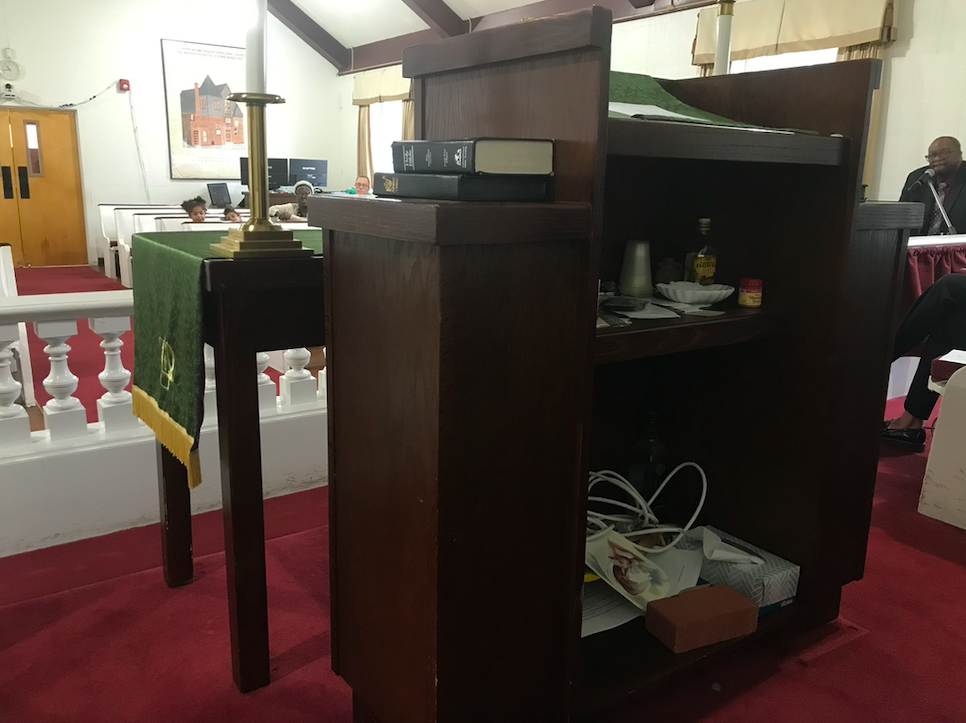
Check out the mustard seeds on the shelf.
I have deep sympathy for Brother Peter because he’s trying to hold on to what is elusive. Brother Peter is should-ing all over this. Peter wants to build a monument. He wants to make solid what is in danger of drifting away. Peter wants to catch a cloud in a bottle. How do you make solid that internal transformation? Church, we can’t. This is the struggle. Those Black Washerwomen? They had to know in their bones that they were worthy without external affirmation of any institution. And Peter, bless his heart, is trying to make this moment stick forever. I know so many deeply faithful churches who are trying to freeze in time a single moment when God is still trying to move them forward.
But, the Lord puts a stop to Brother Peter’s rambling right quick. A cloud descends, and overshadows Peter’s event planning committee and says, “This is my son, the Beloved; Listen to Him!”
Listen to Jesus.
Church, can we stop the rambling for a moment and listen to Jesus? Listen to the one who is whispering to you, “my beloved?” Can you hear it? While the world is shouting profanity, can you hear it? Can you hear it?
Oh Church, listen. Beloved people, listen to Jesus, Christ is calling, calling to you. Telling you, you are beloved. You are so very worthy. Nothing you can say or do can take that away. Nothing you have done, did, or will do can take away your worthiness as a beloved child of God.
I wish we could build a monument, a tower to your worthiness, Church. A giant statue as tall as the heavens to show just how much you are worthy. Brother Peter wanted to, he wanted to so badly! He wanted to gather that dazzling whiteness up and hold onto it forever. Catch that cloud in a bottle. Hold on to the one who would never leave nor forsake you. Build something eternal to the one whose love never ends, make it as bigger than Stone Mountain. But that’s not how God works, Church. God’s love is bigger than the tallest building. Wider than the widest ocean. Deeper than the deepest canyon. Brighter than the most dazzling garment.
Instead of a monument to Jesus’s love, he left us with an empty tomb.
And that empty place in your heart? That place that the Evil One keep trying to fill with cruel words, and lies, and all sorts of falsehoods?
Right there. Right there. Right Into that empty space place Christ’s dazzling love.
Amen.
 RevEverett